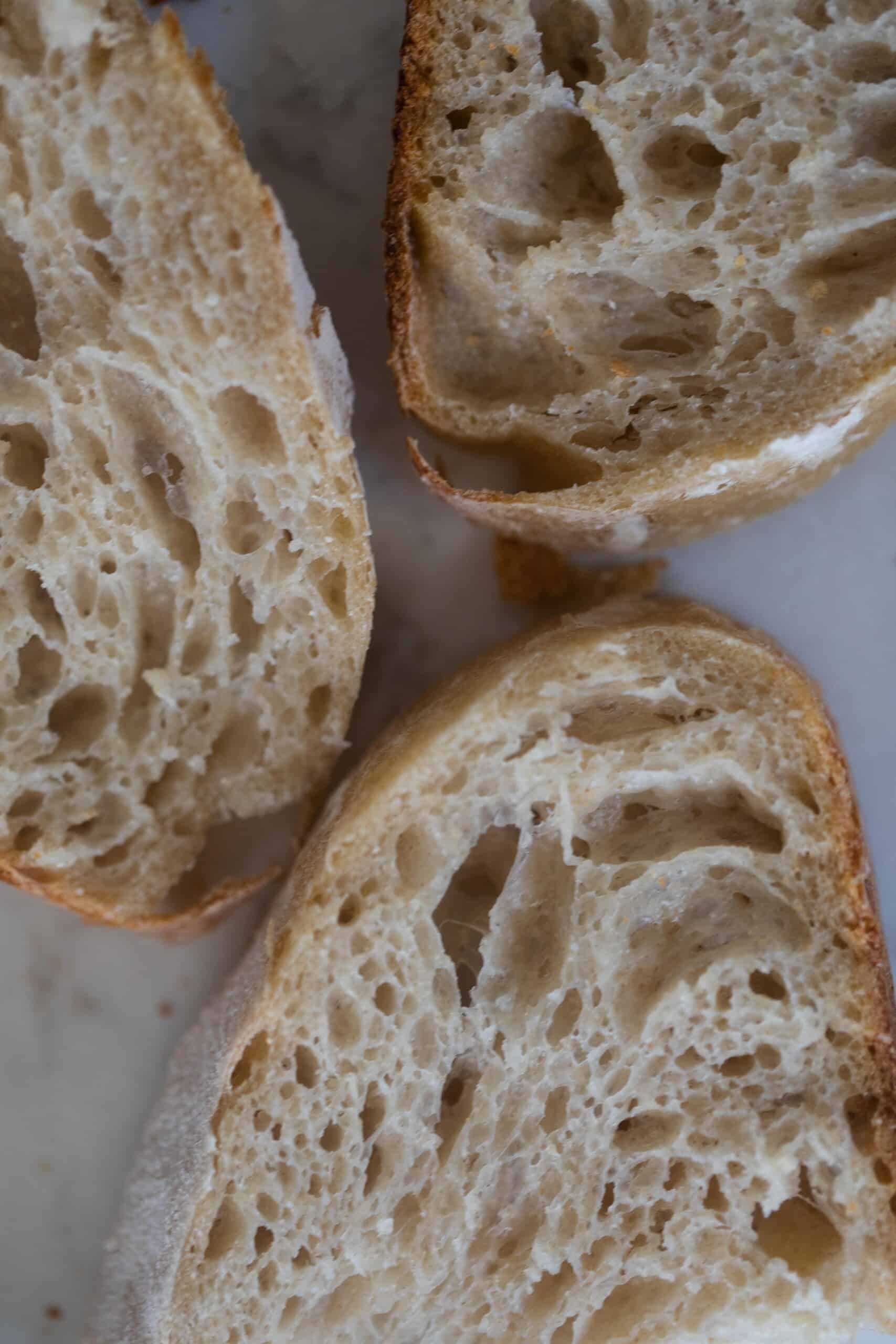
High Hydration Sourdough Loaf
If you are ready to take your sourdough baking skills to the next level, this high hydration sourdough bread recipe is for you. With 82% hydration, this bread has a beautiful open crumb and the most perfect thin, crisp crust.
Ingredients
- 250 grams unbleached all purpose
- 100 grams whole wheat flour
- 125 grams bread flour
- 100 grams sourdough starter, active and bubbly (100% hydration, fed with equal parts flour and water)
- 390 grams water
- 10 grams salt
Directions
- 1
Feed a sourdough starter 4-12 hours before making your bread. The time it takes a starter to double in size and become active and bubbly depends on factors such as temperature and the maturity of your starter.
- 2
Combine the flour and warm water in a mixing bowl. I find using a dough whisk works best for this.
- 3
Allow this mixture to rest for 30 minutes. This is called autolyse, the process of hydrating the flour.
- 4
After the autolyse, add in the sourdough starter by dimpling it in with wet hands.
- 5
Sprinkle the top of the dough with salt.
- 6
Use your hands to mix the dough until it comes together. This takes about 5 minutes. Cover the dough with plastic wrap or a damp tea towel and allow another 30 minute rest.
- 7
This is a no knead recipe. So, for gluten development, perform 6 rounds of stretch and folds.
- 8
With the dough in a large bowl, grab the edge of the dough and firmly pull up, stretching it upwards. Place the dough into the center of the dough ball. Give the bowl a quarter turn and do this same process again. Repeat this one to two times. This is considered one round of stretch and folds. Repeat according to the directions below.
- 9
First 3 stretch and folds – every 15 minutes. Last 3 stretch and folds – every 30 minutes.
- 10
To ensure a beautiful rise and airy crumb, the dough will need to bulk ferment until doubled.
- 11
To do this, cover the dough with a wet towel or plastic wrap to avoid a crust forming. This process may not take as long to ferment as other doughs. Keep an eye on it!
- 12
Add a little bit of flour to a work surface.
- 13
Gently take your dough out of the bowl. Be extra careful with a high hydration loaf!
- 14
Shape it into a ball by creating surface tension. To do this, gently spin it towards you.
- 15
Let it sit out 15-20 minutes uncovered. This time around, you want the dough to form a crust so it won't stick to the banneton basket or tea towel during the overnight rise.
- 16
Turn over and shape. I do this by folding the two sides over to meet in the middle, and then the other two sides.
- 17
Transfer to a floured banneton or bowl with a tea towel, seam side up, smooth side down. Cover with plastic and proof 12-15 hours in the refrigerator.
- 18
Before removing your bread from the fridge, preheat your oven to 500 degrees F for 1 hour.
- 19
Right before this hour is up, remove your dough from the fridge. Dust the top with flour and score using a razor blade or scoring lame.
- 20
Sprinkle the bottom of the Dutch oven with flour or use a piece of parchment paper. Transfer the dough to the Dutch oven.
- 21
Bake for 20 minutes at 500 F degrees with the lid on.
- 22
Take the lid off, turn the oven temperature down to 475 F, and bake an additional 25 minutes or until browned. To ensure your bread is done, use a kitchen thermometer to test the temperature. Sourdough should be around 205 F degrees.
- 23
Carefully take your finished loaf out of the oven. After cooling for a few minutes, take your bread out of the Dutch oven and place on a wire rack to finish cooling.
- 24
Allow your bread to cool completely before slicing into it.