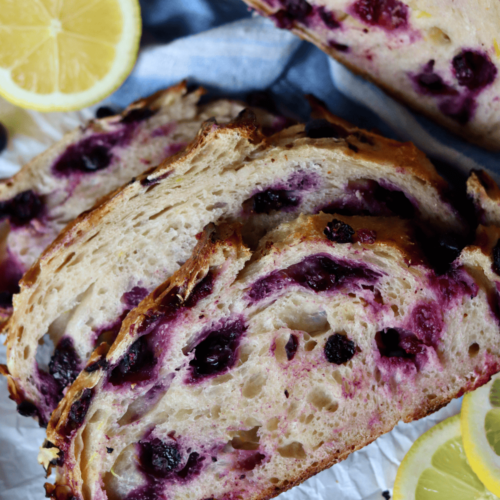
Lemon Blueberry Sourdough Bread Recipe
Ingredients
- 50 gactive sourdough starter
1/4 cup
- 350 gwater
scant 1 1/2 cups
- 500 gbread flour
3 1/2 cups
- 11 gsalt
2 teaspoons
- 150 gfresh blueberries
1 cup
- zest of a lemon
- 113 gunsalted butter
room temperature, 1/2 cup
- 75 gfresh blueberries
- 45 ghoney
2 Tablespoons
- a pinch of salt
Directions
Feed your sourdough starter:
- 1
An active starter can take around 4-12 hours to peak, so adjust to what works best for your situation.
Make the dough:
- 1
In a straight-edge bowl, add the active sourdough starter and filtered water. Mix with a Danish dough whisk or with your hand until it looks like a milky liquid.I love using this straight-edge bowl because it allows me to clearly see when the dough is done rising.
- 2
Then, add the bread flour and salt. Again, mix with a whisk or by hand. Be sure to mix until all of the flour is incorporated. The dough will look shaggy, not like a uniform dough ball.
- 3
Let the dough rest for at least a half hour before you move on to the next step.
Stretch and folds:
- 1
With a bowl scraper, scrape the dough away from the bowl.
- 2
Now, with slightly wet hands, grab a section of the dough and stretch the bread dough above your bowl. Then fold it over on top of the dough.
- 3
Rotate your bowl clockwise a quarter of the way and repeat identical stretch and fold. Repeat the process until you come full circle, about 6 stretch and folds in total. You will notice the dough will start to look much smoother than before.Doing stretch and folds develops gluten in your dough, which is what allows your bread to rise beautifully while it bakes.
- 4
Let the dough rest for another 30 minutes. (Now this is super flexible – you don’t have to stretch and fold every 30 minutes on the dot, but every 30 – 60 minutes will do just fine. As I said, it’s flexible).
- 5
Repeat the identical stretch and fold process three more times (for a total of 4 different rounds), waiting at least 30 minutes between each stretch and fold.
- 6
Cover the dough after each stretch and fold.
Bulk fermentation:
- 1
Now this is the most finicky part of sourdough. There isn’t a set time for your bulk ferment. It is greatly dependent on the temperature of your environment. The warmer it is, the faster your dough will ferment. The opposite is true for cooler temperatures.
- 2
Bulk fermentation begins the moment you mix your dough and continues until you shape your dough.
- 3
In an environment of 70 degrees, doughs will typically bulk ferment for a total of 12 hours, but again, you will have to look for the signs that your dough is done fermenting, rather than the clock. Warm temperatures will be faster, while cooler will be slower.
Here’s what to look for:
- 1
The dough should have increased in size by 75%-The dough looks light, airy and jiggles when shaken.-The dough should easily pull away from the bowl.-There should be visible bubbles on top of the dough.-The dough doesn’t tear when you do a windowpane test.
Pre-shape:
- 1
With slightly wet fingers, gently release the dough from the sides of the bowl. Be careful not to pop all of those lovely bubbles!
- 2
Tilt the bowl and leave gravity to do the work to move the dough on the counter.
- 3
Preshape the dough by doing another round of stretch and folds until you have gone full circle.
- 4
With a bench scraper or your hands, turn the dough upside down, so the seam is now on the counter. Cover the dough with the bowl and let it rest for 30 minutes.
- 5
While you are waiting for the dough to rest, prepare your proofing basket. This can either be a banneton or a small mixing bowl lined with a tea towel. The purpose of this proofing basket is to keep the tight shape that you just created, so make sure you are using a standard bowl that is around 10 inches to help keep the shape.
- 6
Dust the banneton or the tea towel with flour (most will say to use rice flour, but I have used just regular all-purpose flour) to prevent sticking.
- 7
Gather the fresh blueberries and the zest of one lemon. Set them to the side.
Final shape:
- 1
After 30 minutes of rest, flip the dough, with the seam side up.
- 2
Gently stretch the dough into a large rectangle, this is called lamination technique. Be careful not to stretch any sections of the dough too thinly, as the blueberries will break through.
- 3
Spread half of the blueberries and lemon zest over the dough.
- 4
Next, take the left side of the dough and fold it towards the middle. Spread 1/2 of the remaining blueberries and lemon zest on top of this new section.
- 5
Finally, take the right side of the dough and fold that towards the middle on top of the last section, like a tri-fold. Spread the remaining blueberries and lemon zest on top. Now, roll up the dough, starting with the part of the dough closest to you.
- 6
Gently cup your hands around the dough ball. Turn the ball in a clockwise motion about a quarter turn and then softly pull the dough towards you. Do this repeatedly until you see the dough form a tighter and more round shape. Stop if the dough starts to tear. Some blueberries may pop through the dough, this is okay.
- 7
With a bench scraper or just your hands, carefully scope up the dough and lay it upside down (smooth side down) into your floured proofing basket and cover it with a plastic bag or a shower cap.
Cold proof:
- 1
Place your proofing basket in the fridge to cold proof for 8-72 hours.Placing your dough in the fridge slows down the fermentation process, which deepens the flavors of your loaf. It also gives you flexibility in when you want to bake your bread. But don’t wait too long! If left in the fridge for too long, your dough will over-ferment, causing the dough to not be able to rise.
Score:
- 1
Thirty minutes before baking, place the dough in the freezer. This helps with the scoring design.
- 2
At the same time, place your Dutch oven in your oven and preheat to 450 degrees F. Allow the Dutch oven to preheat for at least 30 minutes.
- 3
Place a piece of parchment paper on your workspace and gently flip the banneton upside down over the parchment paper. Since you dusted the banneton, your dough should slowly release and fall onto the parchment paper, landing in the middle with the floured side facing up.
- 4
With a lame or sharp knife, score a crescent moon shape, or any other scoring design your prefer. This is necessary for your bread to be able to expand while baking.
- 5
Grab the corners of the parchment paper and carefully place the loaf into the preheated Dutch Oven and cover it with the lid.
Bake:
- 1
Bake the Blueberry Lemon Sourdough Bread covered for 27 minutes. Then remove the lid of the Dutch oven and continue to bake the bread for an additional 10-15 minutes with the lid off or until golden brown with an internal temperature of 205-210 degrees F.
- 2
Once golden brown, remove the Dutch Oven from your oven.
- 3
Using the corners of the parchment paper, lift the sourdough bread out of the Dutch oven and place it onto a wire rack to cool.
- 4
Allow your homemade bread to cool for at least 1 hour before cutting into it. (I know!! How can you possibly wait when it looks and smells so good?! But trust me, if you cut in too soon, your masterpiece will turn mushy and gummy.) In the meantime, listen to your loaf “sing” its little tune to you with every crinkle and crack.
- 5
Once the hour is up, slice into your work of art, slather on some whipped blueberry honey butter, and enjoy!
Whipped blueberry honey butter
- 1
To a bowl of a stand mixer with the whisk attachment, beat together the room temperature butter, mashed blueberries, honey and salt on high until desired consistency is reached (2-3 minutes).
Lemon Blueberry Sourdough Bread Recipe
Ratings & Reviews
Be the First to Rate
Your rating helps others discover amazing recipes. Share your experience and let others know what you think!
About this Recipe
Brighten Your Day with Lemon Blueberry Sourdough Bread
Get ready to experience the ultimate taste of spring and summer with this incredible Lemon Blueberry Sourdough Bread! This isn't just any bread; it's a culinary masterpiece that combines the signature tang of sourdough with the vibrant sweetness of fresh, juicy blueberries and the aromatic zest of lemon. Perfect for blueberry season, this loaf brings a burst of sunshine to your kitchen and your taste buds.
Our sourdough lemon blueberry bread is designed to be a showstopper. Each slice reveals a beautiful crumb studded with plump, fresh blueberries that practically burst with flavor, perfectly complemented by that bright, sweet lemon flavor. The natural fermentation of the sourdough starter adds a depth and complexity that elevates the simple fruit flavors into something truly extraordinary. Imagine the delightful aroma filling your home as this bakes – pure bliss!
Tips for the Perfect Loaf
To achieve the best blueberry lemon sourdough bread, here are a few pointers:
- Gentle Folding: When incorporating your fresh blueberries and lemon zest, be gentle to avoid crushing the berries too much, ensuring distinct pockets of fruit.
- Lemon Zest Power: Don't skimp on the fresh lemon zest! It's where all that wonderful sweet lemon flavor comes from. Use a microplane for the finest zest.
- Active Starter: Ensure your active sourdough starter is bubbly and strong. This is key for a good rise and open crumb in your sourdough blueberry lemon bread.
Serving Suggestions
This versatile lemon blueberry sourdough bread is fantastic on its own for a simple breakfast or an afternoon snack. It's also divine toasted and spread with a little butter or cream cheese. For a truly indulgent treat, serve slices alongside your favorite yogurt parfait or a light fruit salad at brunch. It’s an irresistible addition to any table, especially when you want to celebrate blueberry season in style!