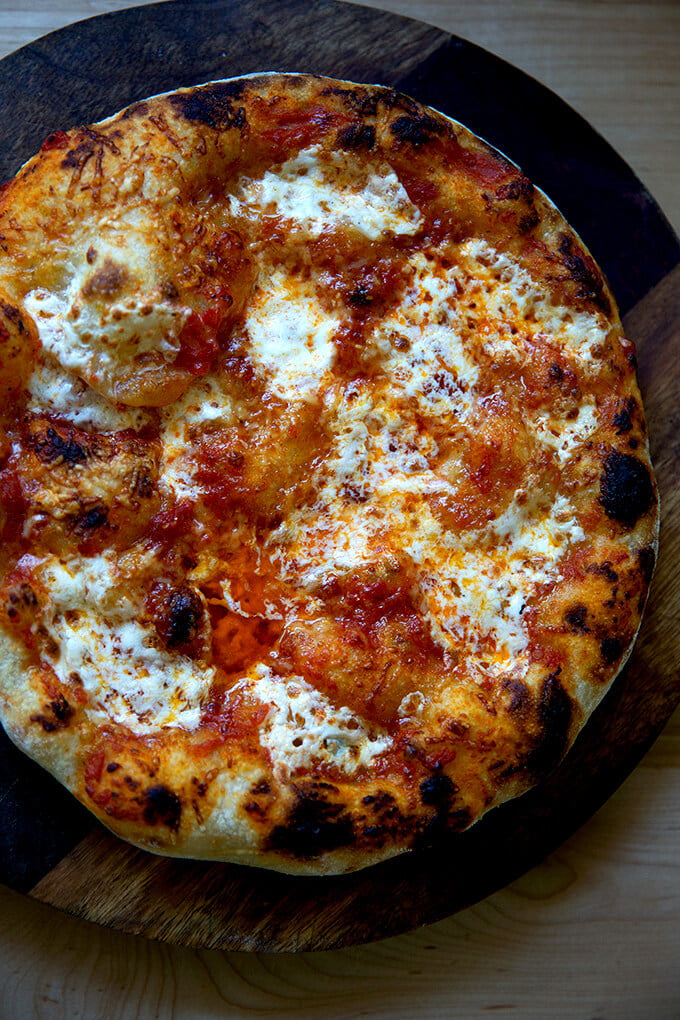
Simple Sourdough Pizza Crust
Ingredients
- 375 g water
or less, see notes above
- 100 g sourdough starter
active and bubbly, see notes above
- 10 g salt
- 500 g all-purpose or bread flour
- 2 tablespoons tomato sauce
- 1 to 2 oz mozzarella
- handful of grated Parmigiano Reggiano
less than an ounce
- drizzle olive oil
- pinch sea salt
- extra-virgin olive oil
- a couple handfuls of baby or Tuscan kale
- 1 to 2 cloves garlic
- Sea salt
such as Maldon
- 2 tablespoons crème fraîche
- grated Parmigiano Reggiano
about 1/4 to 1/3 cup
- 1/4 cup olive oil
- 1/4 cup minced scallions or ramps
- 1 teaspoon crushed red pepper flakes
- 1 to 2 tablespoons crème fraîche
- handful grated Parmigiano Reggiano
- sea salt
Directions
- 1
Place the starter, salt, and water in a large bowl. Stir with a spatula to combine — it doesn’t have to be uniformly mixed. Add the flour. Mix again until the flour is completely incorporated. Transfer to a straight-sided vessel (if you have one.) Cover vessel with tea towel or cloth bowl cover and let stand 30 minutes.
- 2
after 30 minutes have passed, reach into the vessel and pull the dough up and into the center. Turn the vessel quarter turns and continue this pulling 8 to 10 times. See video for guidance. Let the dough rest for another 30 minutes; then repeat the stretching and folding. If possible, repeat this cycle twice more for a total of 4 stretch and folds. By the 4th cycle, you will notice a huge difference in the texture of the dough: it will be smoother, stronger, and more elastic.
- 3
Cover vessel with a tea towel or bowl cover and set aside to rise at room temperature (70ºF/21ºC) for 4 to 18 hours (the time will vary depending on the time of year, the strength of your starter, and the temperature of your kitchen; see notes above) or until the dough has roughly doubled in volume. (UPDATE: In the past I have recommended letting the dough rise until it doubles in volume. If you’ve had success with this, continue to let the dough double. Recently, I have been stopping the bulk fermentation when the dough increases by 50% in volume, and I feel my dough is even stronger in the end.) Note: Do not use your oven with the light on for the bulk fermentation — it is too warm for the dough. When determining when the bulk fermentation is done, it is best to rely on visual cues (doubling in volume) as opposed to time. A straight-sided vessel makes monitoring the bulk fermentation especially easy because it allows you to see when your dough has truly doubled.
- 4
Turn the dough out onto a work surface and shape into a rough ball, using as much flour as needed — the dough will be sticky. Using a bench scraper, divide the dough into 4 equal portions. Sprinkle portions with flour. With floured hands, roll each portion into a ball, using the pinkie-edges of your hands to pinch the dough underneath each ball. Transfer each round of dough to a plastic quart container, cover, and store in fridge for at least 6 hours or up to 3 days or transfer to the freezer (see notes in post about thawing).
- 5
Pull out a round (or more) of dough from the fridge one hour before you plan on baking. Dust dough with flour and place on a floured work surface. Let sit untouched for about an hour (a little longer or shorter is fine). Place a Baking Steel or pizza stone in the top third of your oven. Set oven to 550ºF. Heat oven for at least 45 minutes but ideally 1 hour prior to baking.
- 6
Gently shape dough into a 10-inch (roughly) round handling it as minimally as possible. (See video for guidance.) Lay a sheet of parchment paper on top of a pizza peel. Transfer the dough round to the parchment-lined peel.
- 7
Spread 2 tablespoons of tomato sauce over the surface of the dough. Top with mozzarella to taste. Sprinkle with parmesan to taste. Drizzle with olive oil. Sprinkle lightly with sea salt. Shimmy the pizza, parchment paper and all into the oven. Bake pizza until top is blistered, about 5-6 minutes. Transfer to cutting board. Sprinkle with basil, if you have it. Cut and serve. Discard parchment paper.
Simple Sourdough Pizza Crust
Similar Recipes




Ratings & Reviews
Be the First to Rate
Your rating helps others discover amazing recipes. Share your experience and let others know what you think!
About this Recipe
Tired of relying on takeout for that perfect crispy, chewy pizza? You can achieve a truly spectacular crust right in your own kitchen with this simple sourdough pizza dough recipe.
What makes this recipe stand out is its reliance on a highly active sourdough starter and a flexible approach to fermentation. By using your starter 4 to 6 hours after feeding—when it’s doubled and very bubbly—you unlock incredible flavor and rise. The recipe guides you to observe visual cues, like the dough increasing by 50% to 75% in volume, ensuring you don't over or under-ferment, even with variable kitchen temperatures.
Expect a light, airy sourdough pizza crust with that signature tang, offering a delightful chewiness that holds up beautifully to your favorite toppings. This recipe emphasizes the importance of a straight-sided vessel for accurately gauging your dough’s rise, making the process less intimidating for home bakers. With an initial long fermentation, you'll find the process fits seamlessly into your week, making it entirely feasible to mix the dough mid-week and enjoy fresh, homemade pizza by the weekend.
Feel free to experiment with flour types; while all-purpose flour works beautifully, you can also use bread flour or tipo 00 flour for a slightly different texture. If you're in a humid environment, consider reducing the initial water amount to make the dough more manageable without sacrificing its airy quality. For topping inspiration, the dough pairs wonderfully with classic combinations like tomato sauce, fresh mozzarella, and a sprinkle of Parmigiano Reggiano, or try a vibrant green base with kale, garlic, and crème fraîche.
This sourdough pizza crust recipe is designed for maximum flexibility, allowing you to prepare the dough a few days in advance. It's the perfect canvas for a relaxed weekend pizza night, especially if you plan ahead by mixing your dough on a Wednesday or Thursday. Serve your creations directly from a hot Baking Steel or cast iron skillet for that ultimate crispy bottom.